Project structure and planning, publications, Oliver Grau, Lev Manovich, Soft Cinema, Aesthetic distance, locating the viewer in the archive, visualising time (x and y) navigation, five film concepts, co-authorship, terms of reference, formalising the project, translation, essay, book chapter publication, LSE archival research, project map (future project work) ICCEES, SSEES library, Pich project development, language theory, personal stories, investigating the human, relationships, how to show a viewer where they have been, how I bring Berman online, actions.
Monday, 11 August 2025
Monday, 14 July 2025
Research Meeting with Lisa: 14 July 2025


Manuscript – book research question, threads, archival research, Ukraine, conference presentations, publishing, graphic design, Lev Manovich, Soft Cinema, early 2000s media theory, undergraduate maths, priorities, quick wins, long term planning (end of career) Піч, theory, literature, the development of the Ukrainian language, oral traditions, the ‘window’ in multimedia, reading list, E. H. Gombrich, renaissance windows, national gallery, New York, Columbia University, libraries, Saturday study, interactive film theory, Oliver Grau, cornerhouse Manchester, Virtual Art: From Illusion to Immersion, London archives, Leicester, De Montfort, Woober and Uber, Holocaust testimonies, testimonies project, Rebecca Comay interview, Fortunoff Video Archive, video and testimonies, funding, ARHC recognition, funding application.

Monday, 23 June 2025
New York Photographs
My New York photographs are ready from the lab (Analogue Wonderland). I have re-fallen in love with my 35mm film camera, a Fujica STX-1. I bought it almost 30 years ago when I was doing my art foundation course, inspired by Tim Rundle, now a Principal Lecturer at Nottingham School of Art & Design at Nottingham Trent University, one of the most inspiring and influential individuals of my career.
For my trip I used Kodak Ultramax 400. I did some research into colour photography and particularly liked Saul Leiter, whose work I hadn’t encountered before. A lot of very flat, almost two-dimensional colour photographs that have a strong composition and layout and almost feel like paintings. I also really like Joel Meyerowitz’s work. This link is colour street photography. The quality, colour and composition are all really evocative.
I took most of my photographs on the Brooklyn Bridge. I was there on my last day, by chance it was golden hour, the light was amazing and all of the photographs, both on film and on my iPhone have a particular quality, which I’d never really understood but is what makes golden hour warm and special. I also have an almost identical photograph of Rodin’s The Thinker from Columbia University, even the focus is the same.

Brooklyn Bridge, 2025. Photo: Sara Nesteruk

Brooklyn Bridge, 2025. Photo: Sara Nesteruk
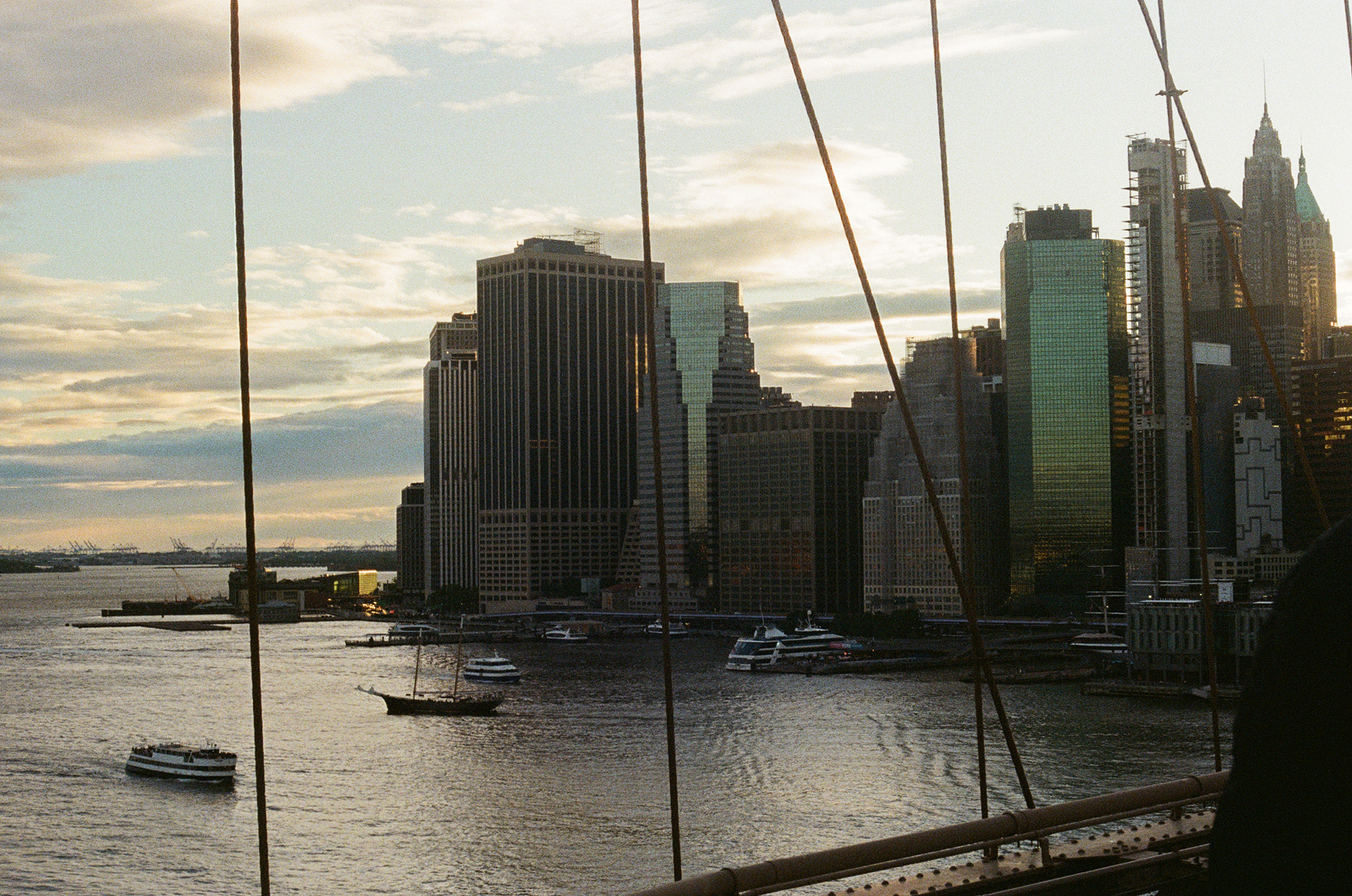
Brooklyn Bridge, 2025. Photo: Sara Nesteruk

‘The Thinker’ by Rodin. Photo: Sara Nesteruk
Monday, 9 June 2025
A Natural History of the Studio
This is a current exhibition of work by William Kentridge. Kentridge’s work includes drawing, erasing, collage, film, performance, music and theatre. He was born in South Africa and grew up under apartheid. His work explores the past and its relationship to the present using tactile forms of production, raw animation techniques and the artist’s studio as a way to describe process, perception and reality. (1)

Figure 1. Pocket Drawings 187–241, 2016. By William Kentridge. Photo: author.

The exhibition is at Hauser & Wirth in two buildings at 18th Street and 22nd Street New York. A Natural History of the Studio explores printmaking in the first gallery venue and in the second a dynamic, stunning show across two floors of the gallery space. On 22nd Street the focus is a piece of working including production materials, drawing, film and sculpture.

Figure 3. Drawing for Self-Portrait as a Coffee-Pot (Mine Dump), 2020. By William Kentridge. Photo: author.

The focus is on Kentridge’s lockdown work completed in 2024, Self-Portrait as a Coffee-Pot. This is an acclaimed series of nine, thirty-minute episodes shot in his studio. The work explores process and is a portrait of a particular moment in the artist’s experience and practice. It includes collage, drawing and video footage of the artist himself. As with many of Kentridge’s works the artist reveals time in a tactile, tangible way through stop-motion animation, drawing and a mix of production techniques that result in a raw, uncomplicated final outcome. The second floor of the gallery includes single screen animation work and sculpture.


Figure 6. Fugitive Words, 2024. By William Kentridge. Photo: author.
1. “William Kentridge,” Hauser & Wirth, accessed 9 June, 2025, https://www.hauserwirth.com/artists/william-kentridge/
Sunday, 25 May 2025
Український музеи, Наукове Товариство ім. Шевченка і Holy Ghost Ukrainian Catholic Church
Українське мистецтво в Нью-Йорку. Я відвідала три виставки в Українському музеї в Нью-Йорку: «Селянське – Модерне» «Юрій Соловій: Абстагування Часу» і «Українська Писанка». Моєю улюбленою картиною вула «Пічка» Давпда Бурлюка.

Давид Бурлюк. Пічка, 1915.
Я також відвідала Наукове Товариство ім. Шевченка для екскурсії бібліотекою та арківами, візит організовано Razom for Ukraine.

Плакат, Наукове Товариство ім. Шевченка. Без дати.
Мій останній візит була до Української католицької церкви Святого Духа. Там я знайшола ці чудові листівки.

Листівки з рецептами, 1974.
Мене особливо цікавлять документи Наукового Товариства ім. Шевченка про життя українців у таборах для переміщених осіб після Другої світової війни.
Sunday, 18 May 2025
Ukrainian Women of Ravensbrück Concentration Camp, Jerry Berman and William Kentridge
Thank you to Ian Gaunt and Iryna Marciuk for a digital copy of Ukrainian Women of Ravensbrück Concentration Camp. Including testimony of voices of Ukrainian women-prisoners of Ravensbrück themselves I am looking forward to reading this publication by Kalyna Bezchlibnyk Butler and published by the Ukrainian Canadian Research and Development Centre (UCRDC) in Canada. The centre has a database of names of Ukrainian women, incarcerated at the camp on its website. I looked for my grandmother.

Ukrainian Women of Ravensbrück Concentration Camp: Voices of Prisoners (2024).

Database: Ukrainian Prisoners at Ravensbrück. Source: http://www.ucrdc.org/Archive-Textual_and_Photo_Records-World_War_II.html
An overview of the biography, work and witness testimony to the Holodomor by Jerry Berman is now on Wikipedia in Ukrainian. Thank you to Yana Hrynko and colleagues for mentioning my work and involvement in the donation of the letters from Alison Marshall to the National Museum of the Holodomor-Genocide in Kyiv in 2021.

In preparation for my visit to Hauser & Wirth I came across this brilliant video by William Kentridge. In it Kentridge responds to a piece of work by Philip Guston from 1969, ‘The Studio’. I had forgotten how much I enjoy Kentridge’s talks and lectures. I love how analogue this is.
Sunday, 11 May 2025
New York and the Original Holodomor Film
Art and film. A gallery tour and the Original Holodomor Film (1983).

Cheslea Gallery Tour
I have created a Chelsea Gallery Tour map using research from Time Out. Most of the galleries are between W 19th Street and W 27th Street. Particular highlights and personal favourites for me are the opportunity to see William Kentridge at Hauser & Wirth and Steve McQueen at Dia Chelsea.

Jurij Solovij. Source: The Ukrainian Museum.
I am also planning to visit Little Island and then walk to the Ukrainian Museum on the Lower East Side for two exhibitions. One of these is Jurij Solovij: Abstracting Time. I am particularly excited about Solovij’s graphic design work which includes book covers, his work on advertisements and wallpaper designs from the 1950s onwards.
The Original Holodomor Film (1983)
I have also just watched The Original Holodomor Film – The Unknown Holocaust by Taras Hukalo for Radio Quebec. This graphic film features interviews with survivors, the oral testimony video style reminds me of Geoffrey Hartman’s descriptions from the Yale Fortunoff Video Archive for Holocaust Testimonies. Expert interviews include Malcolm Muggeridge, James Mace and Marco Carynnyk whose work I read during my PhD. The term Holodomor itself doesn’t appear in the film.
Thank you to Ian Gaunt for links to the Ukrainian Museum and the film.
Subscribe to:
Posts (Atom)